
“Digital Amnesia” Discussed in TÜBİTAK 4006 Science Talks
Within the scope of the “4006 TÜBİTAK Science Talks” program carried out in cooperation with the Ministry of Industry and Technology of the Republic of Türkiye and TÜBİTAK, a talk titled “Digital Amnesia: How Does Technology Change Our Memory?” was delivered by Pamukkale University (PAU) Lecturer Dr. Cansu Öksüz Karademir at Pınar Baha Abalıoğlu Anatolian High School.
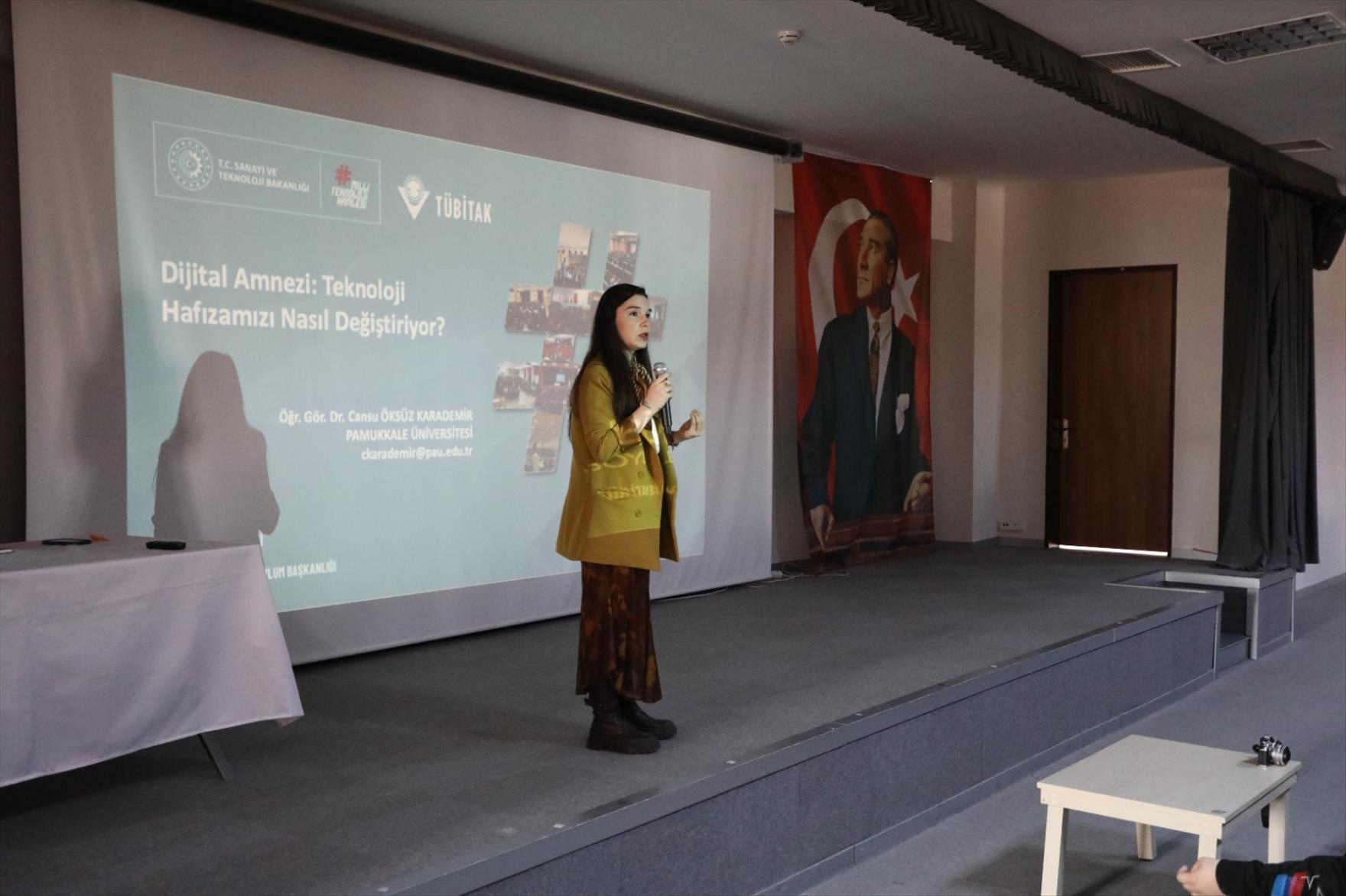
Held on April 13 at Pınar Baha Abalıoğlu Anatolian High School in the Merkezefendi district of Denizli, the event attracted significant interest from students. The activity, conducted within the scope of 4006 TÜBİTAK Science Talks, made an important contribution by bringing scientific knowledge to society and enabling young people to evaluate the effects of the digital age from a critical perspective.
Dr. Öksüz Karademir: “The new generation born into a digital world tends to remember how to access information rather than retaining it in memory; in a period where smartphones function as an ‘external memory,’ the intense flow of notifications weakens sustained attention span.”
In the talk, the effects of digitalization on cognitive memory were addressed within the framework of the concept of “digital amnesia.” It was emphasized that this new form of memory, which emerges as information is increasingly outsourced to digital devices rather than retained in the mind, creates significant transformations in young people’s learning, remembering, and thinking processes. Dr. Öksüz Karademir stated that the new generation, born into a digital world, tends to remember how to access information rather than memorize it, that smartphones function as an “external memory,” and that the intense flow of notifications weakens sustained attention.
Within the theoretical framework of the talk, the concepts of the “Google effect” and “transactive memory” were also discussed, drawing attention to the increasing tendency of individuals to outsource memory load to digital networks. It was also stated that continuous exposure to digital information flow leads to changes in cognitive processes related to attention and memory; and that this transformation is reflected not only at the individual level but also in cultural production and narrative forms.
The permanence of digital traces, the organization of memory by algorithms, and the effects of digital content loss on identity perception were also discussed.
The representations of digital memory were also discussed through film examples during the event. It was noted that narratives in which memory can be deleted or archived like data reflect ways of thinking in the digital age, and that this situation transforms young people’s ways of perceiving and experiencing the world. In addition, topics such as the permanence of digital traces, the organization of memory by algorithms, and the effects of digital content loss on identity perception were also addressed.
The talk was not limited to a theoretical framework; it also included practices aimed at increasing students’ active participation. Within the scope of the event, envelopes distributed to students contained film quotes related to digitalization and memory, along with short questions prompting them to think about these quotes. Students examined these cards and had the opportunity to make their own internal evaluations based on the given statements. These materials were used as a quiet and personal interaction tool aimed at helping students refocus attention and develop individual awareness. In this respect, the application contributed to helping students experiencing attention difficulties refocus on the process.
This process of individual awareness continued alongside other practices carried out within the talk. With the “digital memory map” activity, students made visible which types of information they outsource to digital devices in their daily lives, while with the “notification awareness test” they concretely experienced how their attention is divided. At the end of the event, students were guided to develop their own “personal digital memory strategies” based on these experiences, taking concrete steps toward conscious technology use. In this context, the importance of being aware of and managing memory habits in the digital age was emphasized.