
Deputy Minister Yelkenci Meets Students at PAU: “We Will Think with Our Own Concepts”
The opening program and first lecture of the “İhtisas Academy” project, implemented under the leadership of the Türkiye Youth Foundation (TÜGVA) Denizli Provincial Representation and hosted by Pamukkale University (PAU), was held on April 15 at the Melek Sözkesen Conference Hall of the Faculty of Education.
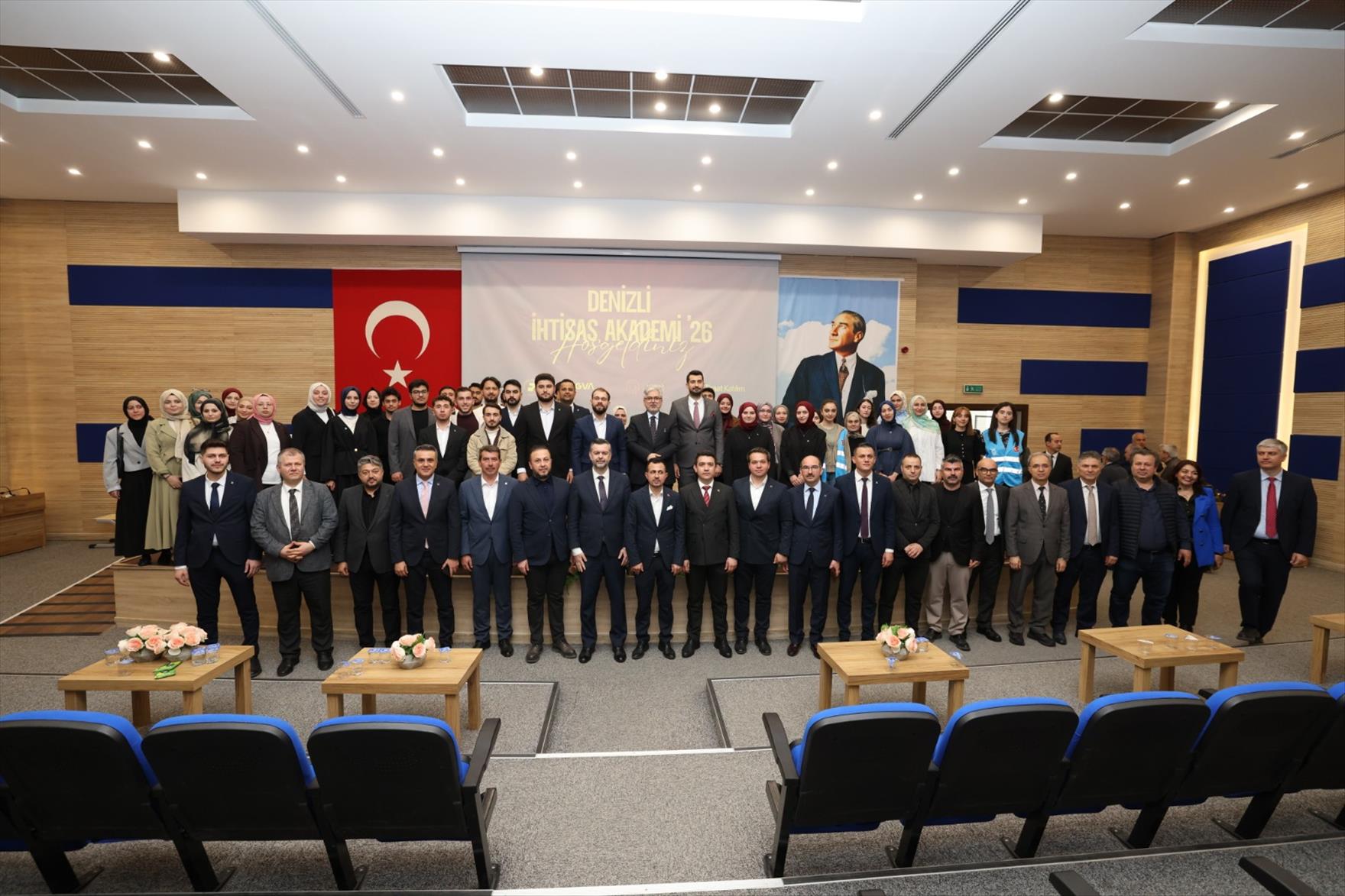
The program, which aims to provide young people with moral and intellectual depth, hosted its first guest, Deputy Minister of National Education Dr. Ömer Faruk Yelkenci, with a presentation titled “Türkiye Century Education Model.” The event was attended by Denizli Governor Yavuz Selim Köşger, Vice Rector Prof. Dr. Mehmet İnel, provincial protocol members, academics, and a large number of university students.
The program began with a recitation of the Holy Quran followed by the Turkish National Anthem. In the opening speech, Denizli Governor Yavuz Selim Köşger drew attention to consecutive attacks targeting the education community in Şanlıurfa and Kahramanmaraş. Governor Köşger stated, “No one can say that these consecutive incidents are coincidences. These are deliberate and systematic attacks aimed at undermining the nation’s trust in its state. Our greatest support is our well-educated youth, who are aligned with the values of the era but have not been detached from their own values.”
Essay Requirement for Youth and Study Abroad Awards
TÜGVA Denizli Provincial Representative Ali Durmuş and Deputy Chairman for Universities İsmail Hakkı Karagül shared the vision of the academy project. Emphasizing that they aim to provide students with not only professional but also moral and intellectual depth, the administrators stated that students are expected to submit an academic article at the end of six courses. It was announced that successful students will be awarded trips to Andalusia, the Balkans, and Umrah, as well as monetary awards specific to Denizli, and that all participants will receive an e-Government-approved certificate in cooperation with PAU.
New Model in Education: A Holistic Skills- and Values-Based Approach
Taking the stage to deliver the first lecture titled “Türkiye Century Education Model,” Deputy Minister of National Education Dr. Ömer Faruk Yelkenci began his speech by commemorating teachers who lost their lives in Şanlıurfa and Kahramanmaraş, stressing that respect for educators must be elevated to the highest level.
He then shared details of the new curriculum, stating that the model has been designed in a holistic structure for the first time in Türkiye, covering preschool to 12th grade (K-12) both vertically and horizontally. Dr. Yelkenci said, “Our aim is to raise a human profile that is productive, inquisitive, healthy, compassionate, aesthetically aware, competent, and virtuous.”
He emphasized that the curriculum, in addition to subject-specific skills, also systematically includes “social-emotional learning skills” for the first time in Türkiye. Explaining the transformation in values education, he said: “We have left behind the old didactic approach to values education. Because you may give the knowledge of a value, but unless it turns into behavior, it has no real worth. A parent may tell a child ‘do not lie,’ but if the parent does not lie, the child will not lie either. Our core design is to transform virtue and value organically into action.”
“The curriculum was written by a strong team of 1,300 Turkish academics”
Addressing public misconceptions such as “the Ministry of National Education is run by the Fulbright Commission,” Dr. Yelkenci stated that these claims do not reflect reality. He said, “This nation senses something but mislabels it. What is referred to is actually the primary education curriculum sponsored by the American Ford Foundation between 1948 and 1968. The Türkiye Century Education Model, however, was written entirely by a strong team of 1,300 Turkish academics and teachers.”
Conceptual Independence Against Colonialism: Turkestan and the Sea of Islands
Explaining the evolution from positivism to postmodernism in educational philosophy, Dr. Yelkenci warned that Western-centered colonial forms always impose their power through their own dominant concepts. He stated, “They first empty the meaning of your own valuable concepts, and then impose their own.”
He explained strategic linguistic changes in the curriculum aimed at building national consciousness: “For years we were taught ‘Central Asia.’ When you say Central Asia, you cannot form a strong emotional bond that it belongs to us, but when you say ‘Turkestan,’ it changes. We have also started using ‘Sea of Islands’ instead of the Aegean Sea. This way, we define both its geographical character and its connection with the islands related to us. Similarly, instead of the term ‘Crusades,’ which is presented in a softened way as if our armies went on campaigns, we use ‘Crusader Attacks,’ which reflects its colonial logic more accurately.”
Referring to sociologist Jean Baudrillard’s concept of “voluntary submission” and Ivan Illich’s critique of schooling, Dr. Yelkenci stated that the West imposes its own systems on the world through its own critiques and that Türkiye must break free from this Eurocentric understanding of history and education.
“Zionism is included in the curriculum as a new form of colonialism”
Stating that colonialism has changed form in the modern era and drawing attention to the events in Gaza, Dr. Yelkenci said that Zionism is now addressed in the curriculum under the title of “new colonialism approach.” Emphasizing the importance of boycotts, he called on young people to remain alert: “Colonizers today are financing the bullets they will use against you tomorrow by selling you coffee, burgers, or clothes today. They transfer the cost of future oppression onto the people they exploit. That is why boycotting is very important.”
He recommended that students read the report of the Gulbenkian Commission chaired by sociologist Immanuel Wallerstein and concluded his speech with the message: “Give the world its magic back.”
The program, which attracted great interest from students, ended after an insightful Q&A session and the presentation of gifts to Deputy Minister Yelkenci by TÜGVA Deputy Chairman İsmail Hakkı Karagül and PAU Faculty of Education Dean Prof. Dr. İzzet Kara.