
Meaningful Event at PAU: A Journey into Earth Sciences with Young Scientists
Pamukkale University (PAU) opened its doors to the scientists of the future on the third anniversary of the February 6 earthquakes. At the Science Café event organized by the PAU Science Communication Coordination Office, children studying at the Children and Youth Education Application and Research Center experienced how earthquakes occur using colorful erasers and observed the behavior of buildings on a shaking table in a safe environment.
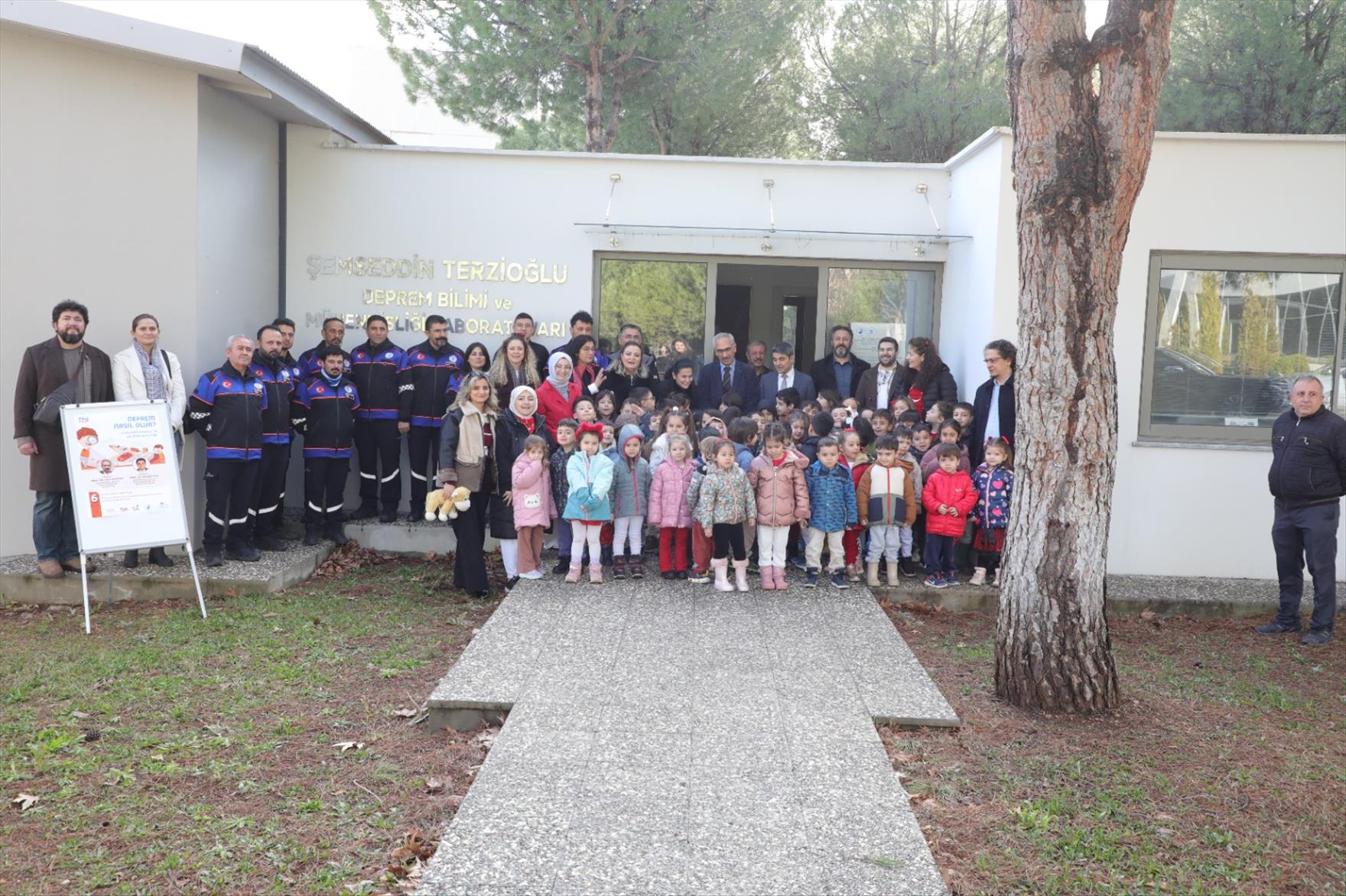
On the anniversary of the February 6 earthquakes that plunged Türkiye into mourning, the PAU Science Communication Coordination Office organized a special awareness-raising event for children. At the event titled “How Do Earthquakes Occur? A Journey into Earth Sciences with Young Scientists,” held at the Şemseddin Terzioğlu Earthquake Science and Engineering Laboratory, children were introduced to the fundamentals of earth sciences and civil engineering.
One day prior to the event, an earthquake seminar was conducted by psychological counseling and guidance specialists for children studying at the PAU Children and Youth Education Application and Research Center.
Speakers at the event included Prof. Dr. Halil Kumsar, Head of the Department of Geological Engineering at the PAU Faculty of Engineering; Prof. Dr. Mehmet İnel, Vice Rector and Head of the Structural Engineering Division of the Department of Civil Engineering; and Haluk Onay Keten, Deputy Provincial Director of AFAD Denizli. Also present at the event were Prof. Dr. Fatma Taşkın Ekici, Director of the PAU Children and Youth Education Application and Research Center; Yıldız Tosun, AFAD Denizli Provincial Director; Assoc. Prof. Dr. Bahar Türk, PAU Science Communication Coordinator; and the PAU Search and Rescue Team.
First Lesson: “Here, we create artificial earthquakes”
At the beginning of the event, Prof. Dr. Halil Kumsar welcomed the children in the laboratory and explained the working principles of the facility in a language they could understand. Kumsar said, “The feature of this laboratory we are in is that we create artificial earthquakes here using a shaking table. We upload records of past earthquakes to the computer and test the durability of buildings. Our aim is to learn and teach how earthquake-resistant buildings are constructed.”
Children conducted fault-breaking experiments with erasers
As the program continued, theoretical information turned into hands-on experiments. Answering the children’s question “What is a fault?” as “a crack in the ground,” Prof. Dr. Kumsar demonstrated fault movements using the colorful erasers distributed to the children.
The children placed the erasers side by side and slid them against each other, simulating “strike-slip” fault movement with their own hands. They then moved the erasers vertically and learned about the “normal faulting” type frequently seen in the Denizli region. Prof. Dr. Kumsar said, “These pieces you are holding like toys actually represent the massive Earth’s crust on which we live.”
Prof. Dr. İnel highlighted what should be done before and after an earthquake
Following the geology session, Prof. Dr. Mehmet İnel took the floor and drew attention to what should be done before and after an earthquake. Emphasizing that children should not be afraid of laboratory equipment, Prof. Dr. İnel reassured them by saying, “The devices will create the earthquake, we will see how buildings shake, but they will not harm us at all.” He delivered a presentation highlighting the importance of constructing sturdy buildings and the necessity of an emergency earthquake kit.
AFAD assigns a “hazard hunt” task to children
In the next phase of the event, AFAD Denizli Deputy Provincial Director Haluk Onay Keten addressed the children. Introducing his AFAD uniform, Keten described earthquakes as “a natural event, like rain or storms,” helping to ease the children’s fears. He also gave the young students a homework assignment, asking them to conduct a “hazard hunt” at home with their parents, identify cabinets, pictures, and chandeliers that could fall during an earthquake, and secure them. In the final part of his talk, he conducted a “Drop–Cover–Hold On” drill with the children next to their desks.
A realistic experiment on the shaking table
One of the most exciting moments of the event took place during the final session. The children gathered around the shaking table. Under the guidance of Prof. Dr. Mehmet İnel and Prof. Dr. Halil Kumsar, the behavior of model buildings during an earthquake was tested on the large shaking table. As the intensity of the shaking was gradually increased, the children watched in amazement how the building swayed without collapsing. During the experiment, the way unsecured items inside the building toppled was demonstrated using toy examples, visually proving the vital importance of “securing furniture.”
The event concluded with the instructors emphasizing, “You will be the engineers of the future and you will build safer cities,” followed by commemorative photographs taken with the children.