
Rector Güngör Attended the “Transforming World: Energy, Climate and Sustainability” Event
Pamukkale University (PAU) Rector Prof. Dr. Mahmud Güngör attended the panel titled “Transforming World: Energy, Climate and Sustainability,” held within the scope of the 50th Anniversary Events of the Faculty of Engineering.
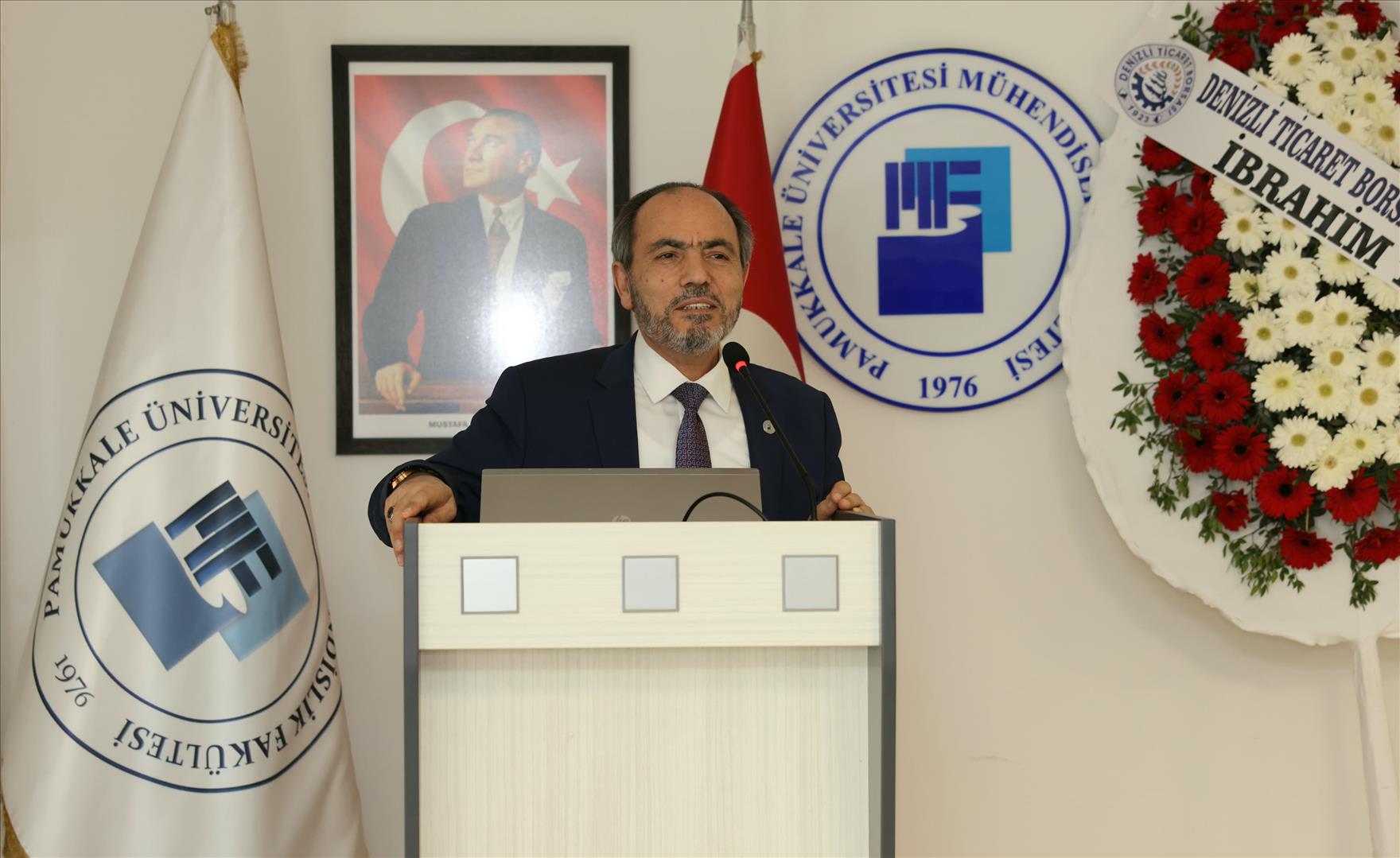
The panel, organized in collaboration with the Department of Environmental Engineering of the PAU Faculty of Engineering, MÜSİAD Denizli Branch, and the PAU Geothermal Application and Research Center, addressed topics such as energy policies, climate change, sustainability, and renewable energy.
In the opening speech of the panel, MÜSİAD Denizli Branch Energy and Environment Sector Board Chair Ali İhsan Keskin stated: “Today we are not only discussing the problems of today, but also the most important issues of our future. Energy transition, climate change, and sustainability are no longer merely academic or environmental issues; they are strategic topics at the center of economic development, industrial policies, and social welfare. The world is going through a very rapid transformation process. Production and consumption habits are changing rapidly, energy sources are diversifying, and environmental sensitivities are gaining increasing importance. In this transformation process, it is crucial that the scientific knowledge of our universities and the experience of the business world come together. As MÜSİAD Denizli Branch, we continue to be involved in producing knowledge, developing solutions, and shaping the future. The interest of our young people in this field gives us hope for a sustainable future, because the world of tomorrow will be shaped by generations that are environmentally conscious, use technology correctly, and protect nature while producing.”
In his opening speech, Head of the Department of Environmental Engineering at PAU Faculty of Engineering, Prof. Dr. Meltem Bilici Başkan stated: “Today we will discuss an important topic together here. We will talk about the future of humanity, the future of our planet, and our way of life. First of all, I would like to express my great happiness and pride in being part of our faculty, which has a half-century-long deep-rooted history, experience, and engineering tradition on the occasion of its 50th anniversary. Throughout 50 years, it has played an important role not only in the development of our region but also of our country through the qualified engineers it has trained, the scientific studies it has conducted, and the contributions it has made to society, and it will continue to work with this awareness. The topics we will discuss today—energy transition, climate crisis, and sustainability—actually show us how much responsibility engineering will continue to bear in the future. At the beginning of my speech, I would also like to express a special thanks. The fact that our Rector was trained in the Hydraulic Department of our faculty and worked in this field for many years is, in my opinion, very valuable. I believe that a management approach that scientifically understands the relationship between water, energy, climate, and environment contributes significantly to our university. Energy, climate, and sustainability are now on the agenda not only of academia but also of industry and the business world, and in this sense, university–industry cooperation is of great importance. The support of MÜSİAD for this panel is a good example of the culture of common sense and collective action regarding sustainable development and environmental responsibility. I believe that such collaborations, which bring together scientific knowledge and the experience of the production world, are very valuable for our future. Today, the whole world is in an energy transition, and renewable energy sources are gaining great importance. Solar and wind energy are no longer just alternative energy sources but have become primary energy investments for many countries. Energy efficiency, circular economy, carbon reduction, and green technologies are becoming increasingly important. For this reason, I find this panel we are holding today very meaningful. In today’s world, while powerful countries are those that consume the most energy, in the future, powerful countries will be those that manage energy in the most efficient, cleanest, and most sustainable way. I once again proudly celebrate the 50th anniversary of our faculty and wish our panel a productive outcome. I would like to thank all our speakers and guests.”
In his opening remarks, Rector Prof. Dr. Mahmud Güngör stated that universities bear an important responsibility in sustainability-focused studies and emphasized that scientific work in the fields of environment and energy is crucial for shaping the future. Rector Güngör concluded his speech by saying: “A world shaped by innovative ideas stands before you. Those who will manage the energy transition, find solutions to the climate crisis, and build and sustain sustainable cities are you. Therefore, keep your minds clear and your hearts open. Wherever you can gain knowledge and experience—from your professors or from industry—go all the way. The opportunity is yours. Thank you all.”
Following the opening speeches, the panel titled “Transforming World: Energy, Climate and Sustainability” began. Moderated by MÜSİAD Energy and Environment Sector Board Chair & Electrical-Electronics Engineer Bülent Şen, the panel opened with his presentation titled “Energy Outlook for 2050 in the World and Turkey.” The panel continued with a presentation titled “An Overview of Renewable Energy Sources in Turkey” by Dr. Lecturer Yağmur Meltem Aydın Kızılkaya, Deputy Director of the PAU Geothermal Application and Research Center. It proceeded with a presentation titled “Environmental Practices and Climate Change” by MÜSİAD Energy and Environment Sector Board Member and Environmental Engineer Nilgün Böcekli, followed by the final presentation titled “Evaluation of the Climate Law from the Perspective of Climate Science” by Assoc. Prof. Dr. Sibel Çukurluoğlu of the PAU Faculty of Engineering, Department of Environmental Engineering, and the panel concluded.