
Denizli Water Workshop Concludes with Closing Session Attended by Rector Güngör
The Denizli Water Workshop, held on March 24–25 under the chairmanship of Prof. Dr. Mutlu Yaşar, a faculty member of the Department of Civil Engineering at Pamukkale University (PAU) Faculty of Engineering, and hosted by PAU, concluded with a closing session attended by Rector Prof. Dr. Mahmud Güngör.
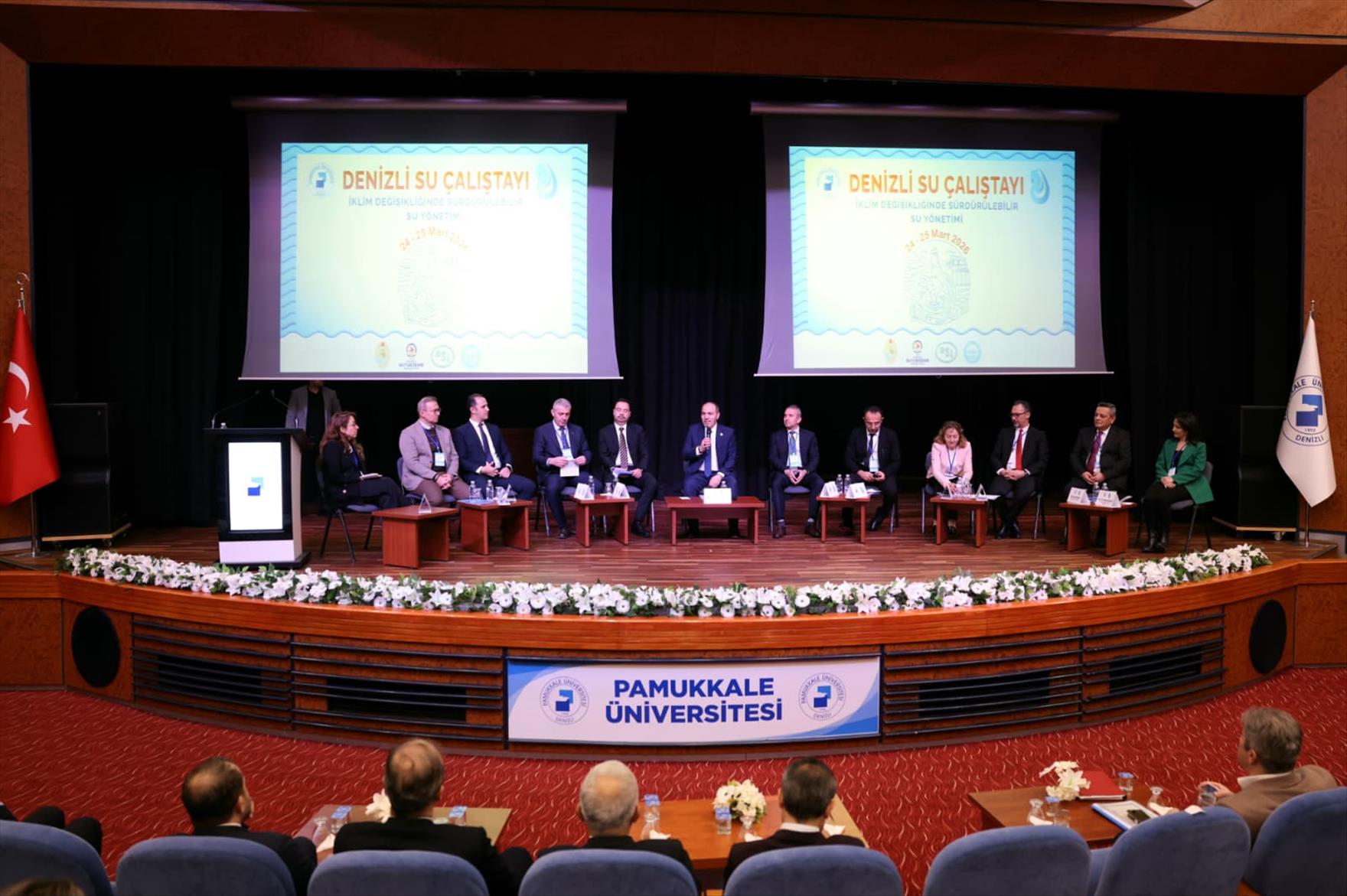
The Denizli Water Workshop, which took place over two days in six sessions at the Prof. Dr. Hüseyin Yılmaz Congress and Culture Center, was completed with the “Sustainable Water Management in Climate Change Outcome Declaration” prepared as a result of the workshop.
Policy Brief
The policy brief emphasized that climate change, increasing water demand, and declining groundwater levels are putting serious pressure on water security, and highlighted that water management should be addressed together with agriculture, energy, rural development, and environmental policies. The outcome declaration identified the protection of groundwater, measurement and limitation of water withdrawals, expansion of modern irrigation techniques, strengthening of basin-based management approaches, and evaluation of artificial aquifer recharge practices as priorities for sustainable water management; it also pointed out that the protection of water resources is not only an environmental goal but a strategic necessity for food security, economic stability, and social resilience.
The “Sustainable Water Management in Climate Change Outcome Declaration” addressed at the closing of the Denizli Water Workshop hosted by PAU included the following headings:
Climate Change
Analyses conducted in the Büyük Menderes Basin and Denizli revealed that precipitation in some sub-basins may decrease by 15–20% and that groundwater levels show a declining trend in approximately 90% of observation wells, indicating that the region faces a serious risk of water crisis.
Awareness activities at local and national levels should be increased through public service announcements regarding the importance and efficient use of water. Incentive mechanisms should be developed to promote rainwater harvesting and storage systems and the use of greywater. Practices such as rain trenches, rain gardens, and natural water surfaces should be explored and implemented in suitable areas in urban and peripheral regions.
The initiation and expansion of drought-resistant landscaping practices by the Metropolitan Municipality and District Municipalities is commendable. In this direction, it is recommended to gradually reduce the lawn-dominated green space approach that causes high water consumption, to apply drought-resistant plant patterns in wider areas, and to expand landscaping policies that increase irrigation efficiency across the city.
In order to sustainably plan Denizli’s drinking water infrastructure, the Drinking Water Master Plan should be revised by taking climate change conditions into account. Existing water management plans should be transformed into dynamic systems that include global climate models and basin-based smart water budget projections in addition to past data.
The amendment to the Planned Areas Zoning Regulation published in the Official Gazette dated March 11, 2025, numbered 32838, which made rainwater systems mandatory for new private buildings larger than 1,000 m² and public buildings larger than 10,000 m², was considered an important and appropriate step. However, in order to expand rainwater harvesting practices throughout Denizli, it is recommended that this obligation should not be limited only to large parcels and buildings with large roof areas; local regulations should be developed to ensure its gradual implementation in smaller new constructions as well, feasibility studies for rainwater harvesting projects should be prepared, and rainwater recovery systems should be made mandatory within a broader scope in new building permit processes.
Within Pamukkale University, it is recommended to establish a permanent “Climate Change and Water Management Center” that will carry out data analysis, modeling, and inter-institutional coordination in the field of climate change and water resources, and base decisions on scientific grounds.
In order to eliminate the complexity of authority and responsibility in water management, the Draft Water Law should be enacted as soon as possible. Until this process is completed, Law No. 167, especially regarding groundwater, should be revised in accordance with current needs and sanctions should be made deterrent. In addition, the measures in the Water Efficiency Strategy Document and the related action plan should be implemented decisively, and institutions obliged to obtain the Blue Water Efficiency Certificate should complete their application processes.
Drinking Water
It is recommended to utilize the existing storage capacity of the Governor Recep Yazıcıoğlu Gökpınar Dam to collect and store waters that are currently released without being stored, particularly during winter in the Böceli intake region. In this way, it is aimed to create an additional reserve for drinking water by supplying additional water without the need for a new storage investment. While preserving the dam’s primary function of agricultural irrigation services, it is considered appropriate that a planning report for the use of water that can later be conveyed to the dam by derivation for drinking water purposes be prepared by the State Hydraulic Works (DSİ). It has been considered important to reach inter-institutional agreement for the realization of project and infrastructure investments with the DESKİ budget following feasibility studies.
It is of importance that the construction of the Acıpayam Akdere Dam and its related units (treatment plant, transmission line, etc.), which will meet the drinking water needs of the districts of Acıpayam and Serinhisar, be evaluated by the General Directorate of State Hydraulic Works within budget possibilities and proposed for inclusion in the Investment Program; additionally, the planning process of the Acıpayam Sırçalık Dam should be accelerated to move first to the project phase and subsequently to the construction phase.
The current drinking water budget of Denizli province is approximately 100 million m³ annually. The decreases in groundwater levels presented within this workshop, the pressure on the city’s drinking water budget, and the expected future increases in demand bring to the agenda the need to conduct studies for supplying drinking water from the Bekilli Karasu source or alternative sources. In this context, it is recommended to determine and evaluate the current and projected drinking water supply-demand status of Denizli province by ensuring that the reliable flow rate to be obtained from the source is secured by taking into account existing uses and downstream water rights.
The main reason for considering the Bekilli Karasu source as a priority solution is the increasing risk that deep wells, whose water levels are gradually declining under the pressure of global warming and drought, may be insufficient to meet urban water demand in the short and medium term. The fact that the source is a significant high-flow alternative with the potential to be transmitted to the city center and does not require any storage facility (such as a dam) during water supply makes the project strategically advantageous. In addition, the fact that the source water directly meets drinking water quality standards, thus eliminating the need for costly treatment processes, and that it can potentially eliminate energy consumption arising from deep well pumping and lifting operations at a macro scale, are considered key factors supporting the environmental and economic sustainability of the project.
In order to develop long-term water management strategies and sustainably plan the urban drinking water infrastructure, it has been considered necessary to prepare the Denizli Province Drinking Water Master Plan by taking current climate change conditions into account, using the Denizli Province Drinking Water Projection prepared within the scope of the Büyük Menderes River Basin Plan prepared by DSİ as a basis. In order for this planning process to be carried out in line with scientific foundations and engineering principles, it is recommended to establish an official cooperation protocol between Pamukkale University and the Denizli Water and Sewerage Administration General Directorate and to carry out the process in cooperation with DSİ. Through this coordination among institutions, it has been concluded that it is important to initiate the necessary project studies related to the city’s water management.
It is recommended to make it mandatory to install flow meters on all drilling wells used by public institutions, private organizations, and farmers, and to record and control groundwater withdrawals. Withdrawal quotas should be applied to all wells and a strong inspection mechanism should be established. It should be based on the principle that water resources are public strategic assets and unlimited withdrawal should not be allowed.
Water loss management in administrations should be carried out not only through declaration-based systems based on ratio calculations but with a holistic methodology covering data and information management systems, planning processes, network operation, asset management, and disaster-resilient water management practices. Water, energy, personnel, and financial efficiency should be monitored through performance indicators, and pressure control management should be effectively implemented to reduce losses. At the same time, the Denizli Metropolitan Municipality is required to reduce drinking water loss rates to the levels determined by legislation.
Within the framework of the National Water Plan (2026–2035), the 11 actions defined under the strategy for the protection and sustainable management of drinking and utility water resources must be implemented by relevant institutions and organizations for Denizli province.
Wastewater
Due to the use of the Büyük Menderes River as an irrigation canal and irrigation from this river by neighborhoods, it is recommended to determine appropriate treatment processes for waters to be discharged into the Büyük Menderes River and its tributary Çürüksu Stream by considering agricultural irrigation standards, and to design the planned “Denizli Central Wastewater Treatment Plant (215,000 m³/day), Collector Line (65 km), Irrigation (4,000 ha)” investment in line with these criteria. Considering that the discharge water of the said investment will be used in agricultural irrigation and must meet the necessary nitrogen and phosphorus requirements, it is recommended that it be included in the State Hydraulic Works Investment Program within the scope of the Büyük Menderes Basin Umbrella Project and implemented accordingly. Thus, by directing a volume equivalent to the amount of water to be obtained by supplying treated wastewater to irrigation, by reducing it from existing irrigation allocations, toward drinking water use, it may be possible to increase the drinking water allocation of the Gökpınar Dam and to use other irrigation waters for drinking water purposes as well.
Regarding the reuse of treated wastewater, it is recommended that municipalities, organized industrial zones, and the chamber of industry meet at least twice a year and reach agreement on implementation principles. This agreement should be transformed into concrete projects that will encourage the use of treated wastewater in industry and agriculture and reduce pressure on groundwater allocations, in line with the goals of “Circular Economy and Water Efficiency.”
Since the Büyük Menderes River and its tributaries are used for agricultural irrigation, the receiving environment standards for industrial wastewater discharged into these environments should be made stricter. The pre-treatment conditions of enterprises discharging into the sewer system should be aligned with the operating standards of central wastewater treatment plants. Discharge limits should not be limited only to the Water Pollution Control Regulation but should be determined at a level that will also meet irrigation water quality criteria. The measures determined within the scope of River Basin Management Plans must be implemented by responsible institutions, especially the Provincial Directorate of Environment, Urbanization and Climate Change.
Irrigation
It is recommended to transition from traditional open irrigation canals to closed systems and to modern irrigation methods such as drip and sprinkler irrigation, especially in the plains of Çivril, Çal, and Baklan irrigated from Çivril Işıklı Lake and in the plains of Sarayköy and Pamukkale irrigated from the Adıgüzel and Cindere dams.
It is recommended to provide training and technical support to at least five hundred farmers within one year under the Provincial Directorate of Agriculture and Forestry in all districts of Denizli province on water efficiency, climate adaptation, and modern irrigation techniques.
Flood
In flood channel and stream rehabilitation projects planned by DSİ, expropriation processes should be accelerated by the relevant municipalities and delays in the implementation process should be avoided. In Denizli city center, certain parts of stream beds have been rehabilitated in past years and flood control has been ensured. However, the expropriation of the Denizli Merkezefendi Akçay Stream and Denizli Merkezefendi Karaçay Stream rehabilitation works must be completed by the Metropolitan Municipality in accordance with regulations and circulars, and the route must be delivered to the State Hydraulic Works without disputes. If included in the Investment Program after expropriations, the flood problem of the city center will be resolved.
Although project design, construction, and inspection services related to rainwater infrastructure can be carried out by DESKİ upon request, the financing of these works must be covered by the relevant municipalities.
In order to analyze and manage flood risks in Denizli basins using scientific methods, it is recommended to initiate cooperation among Pamukkale University, the General Directorate of Water Management, and the State Hydraulic Works. In this context, it is necessary to complete Flood Management Plans; to publish flood hazard and risk maps with up-to-date hydrological and hydraulic data, to prepare new maps for unstudied risky areas, and to revise existing maps by considering climate change and physical changes.
It is recommended to expand community-based disaster trainings under AFAD coordination, conduct flood drills in schools and local administrations, and disseminate early warning systems whose prototypes have been completed by the Denizli Water and Sewerage Administration.
Establishment of a “Climate Change and Water Management Center” Proposed
The recommendations put forward within the scope of the Denizli Water Workshop have shown that the city’s water management should be carried out with a holistic approach addressing issues such as climate change, decreasing precipitation, declining groundwater levels, increasing water demand, agricultural irrigation pressure, wastewater reuse, and flood risk together. In this direction, it is recommended to establish a “Climate Change and Water Management Center” within the university to strengthen university-public-industry cooperation, evaluate water issues on a scientific basis, and develop application-oriented projects. In this framework, strengthening drinking water supply security, controlling groundwater withdrawals, transitioning to closed and efficient irrigation systems, expanding the reuse of treated wastewater, managing flood risks in light of up-to-date data, developing rainwater harvesting and drought-resistant landscaping practices, and establishing structural mechanisms to support scientific data production and inter-institutional coordination are of great importance. As a result, the issues included in the declaration should be considered as local priorities aligned with the National Water Plan. Clearly defining these recommendations in terms of responsible institutions, financing models, implementation schedules, and monitoring mechanisms and transforming them into concrete steps is of vital importance for Denizli’s water security, economic sustainability, and social resilience.