
“Slow City” Çameli Tourism Roadmap Workshop Held with the Participation of Rector Güngör
The “Slow City Çameli Tourism Roadmap Workshop,” organized in cooperation with Pamukkale University (PAU) and hosted by Çameli Municipality, was held at the Çameli Hayri Dev Cultural Center.
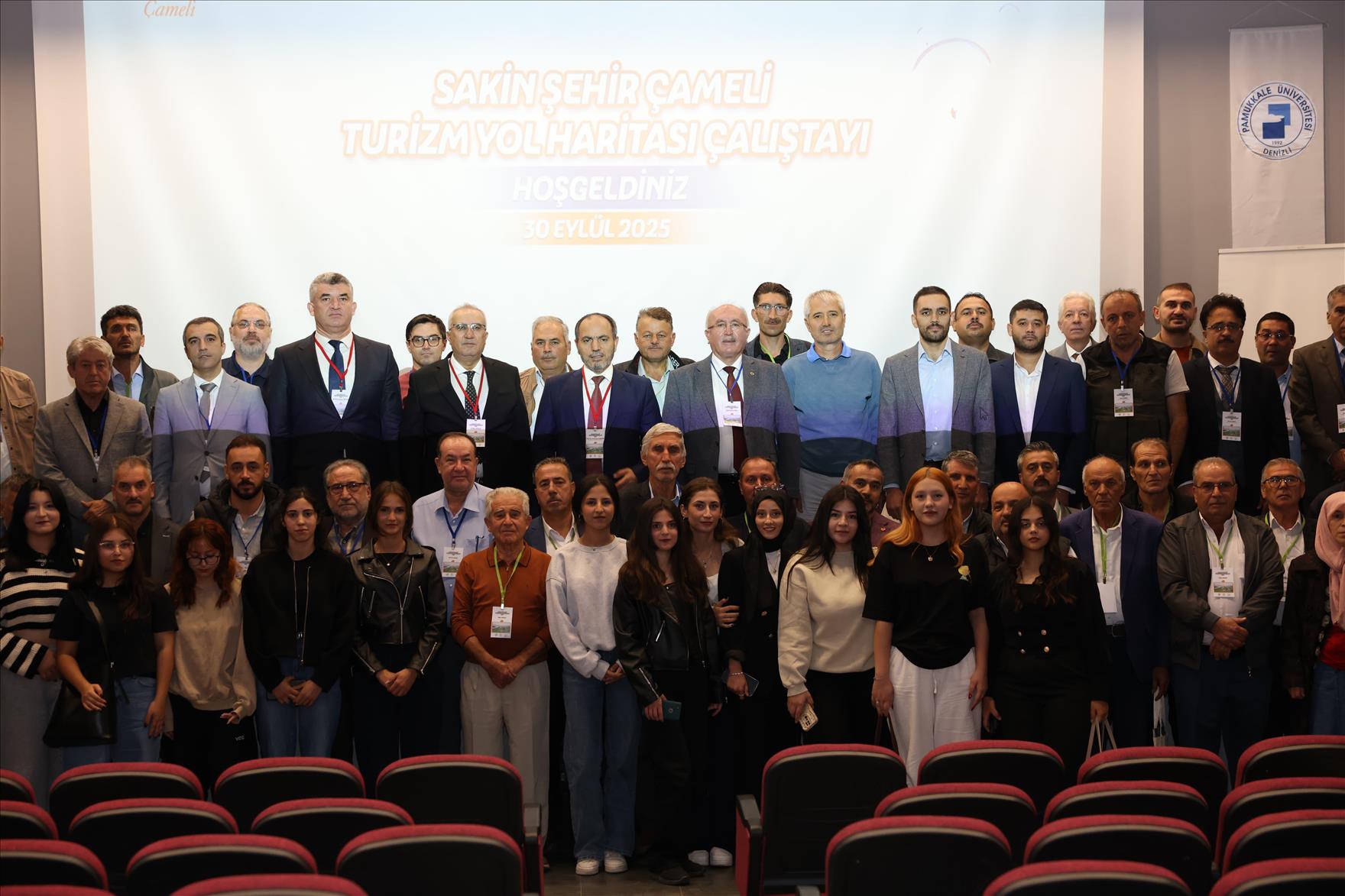
The workshop was held to develop applicable and realistic solution proposals on topics such as the promotion, marketing, branding of Çameli, marketing of local products, transportation-travel-infrastructure, creating/developing tourism products, culture, gastro, agro and shopping tourism, nature/eco, highland, rural, camping and caravan tourism, winter-hiking-mountaineering-biking-air sports and sports tourism. The workshop started with opening speeches. First, Denizli Provincial Director of Culture and Tourism Hüdaverdi Otaklı delivered a speech.
Otaklı: “Çameli will benefit economically from tourism; new income opportunities and employment will arise for our people.”
Denizli Provincial Director of Culture and Tourism Hüdaverdi Otaklı stated: “Today, we have come together here to evaluate the rural tourism potential of our district Çameli and to discuss future steps. Çameli is rapidly advancing to become one of the most advantageous regions in our country in terms of rural tourism, with its natural beauties, cultural richness, and peaceful life. In the last 20 years, our district has achieved significant developments in urbanization, development, and especially tourism infrastructure. During this process, the devoted efforts of our Çameli Mayor, Mr. Cengiz Arslan, and the support of Denizli Metropolitan Municipality played a major role. Now, we are able to talk about, plan, and direct tourism in Çameli. We have significant potential in many areas, especially gastronomy, nature tourism, and rural tourism. This workshop has contributed to the district’s tourism vision and enabled valuable ideas to emerge. The light we see shows that Çameli will benefit economically from tourism; new income opportunities and employment will arise for our people. I believe these studies will yield concrete results in the short term, and in the coming years, Çameli will become one of the exemplary centers of rural tourism. I would like to thank everyone who contributed to our workshop and greet you all with respect.”
Mayor Arslan: “As the municipality, we are ready to open the way for all investments. This workshop will also serve as a roadmap for us.”
Çameli Mayor Cengiz Arslan said: “When I took office in 2014, we set two main goals for Çameli: Agriculture and tourism. Today, we have made significant progress in both. With the pandemic, our district attracted more attention due to its natural structure, highland climate, and peaceful life. This made our district an attractive center for tourism. With our proximity to Fethiye, its clean air at 1300 meters altitude, and our unique culture, we have now become a district that earns income from tourism. In this journey, which started with projects such as Stone Mansions, many small family businesses have begun to develop through tourism. By obtaining the Slow City (Cittaslow) title, we gained an international identity. We stand out in many areas, such as paragliding, highland tourism, gastronomy, and nature sports. However, more accommodation capacity and new businesses are needed. As the municipality, we are ready to open the way for all investments. This workshop will also serve as a roadmap for us. I would like to thank everyone who contributed and state my confidence in Çameli’s tourism future.”
Rector Güngör: “As a university, we will also do our part, increasing the number of students at Çameli Vocational School and working towards opening new programs related to tourism in the future.”
PAU Rector Prof. Dr. Mahmud Güngör said: “Çameli, with its nature, cultural richness, and the Slow City title it has recently obtained, is one of Denizli’s shining values. I have followed this beautiful district closely for years and have visited it many times; I am proud of the progress it has made. The investments and projects carried out highlight the district not only in agriculture but also in tourism. With projects such as Stone Mansions, tourism infrastructure has been strengthened, and significant potential has emerged in areas such as highland tourism and gastronomy. I believe these developments will continue to increase. As a university, we will also do our part. Especially, increasing the number of students at Çameli Vocational School and opening new programs related to tourism in the future will be among our goals. Taking care of students in the district is also our responsibility. We fully trust the hospitality of the people of Çameli. We also see that Çameli has become one of Turkey’s leading regions in highland tourism. Therefore, interest in the district increases every day. Our academic and social contributions will continue. I believe this workshop will also shed light on Çameli’s tourism future, and I thank everyone who contributed.”
Dean Bertan: “Preparations have started for applying Çameli to the ‘Best Tourism Village’ competition.”
PAU Faculty of Tourism Dean Prof. Dr. Serkan Bertan, in his informative speech for the workshop, emphasized that measurable goals should be set for the development of district tourism. According to 2024 data, 2,049,000 tourists visited Denizli, but only 32% stayed overnight. In Çameli, 1,139 people stayed, mostly domestic tourists. The average stay in the district is 2 nights, above the national average, showing the district’s potential. One of the targets for 2026 is to attract at least 16,500 tourists to the district and increase the average stay to 3 nights. Dean Bertan stressed that the Slow City (Cittaslow) title would play a very important role in international promotion and stated that preparations have started for applying to the “Best Tourism Village” competition. Projects such as a local market and gastronomy tourism in Elmalı Neighborhood are being developed. He asked participants to ensure that the suggestions discussed at the workshop are practical and measurable, rather than abstract wishes. Instead of general recommendations like “Promotion should be done,” ideas including target numbers, project steps, and timelines are more meaningful. He also mentioned digital projects developed by Pamukkale University, such as the mobile audio tourism guide and Denizli local cuisine inventory, noting that Çameli has a special place in these projects.
After the speeches, Çameli Mayor Cengiz Arslan presented a certificate of appreciation to PAU Rector Prof. Dr. Mahmud Güngör. Following a group photo, the workshop continued with morning and afternoon sessions in which working groups evaluated problems and solution proposals.