
103rd Anniversary of August 30 Victory Day Celebrated at PAU
The 103rd anniversary of August 30 Victory Day was celebrated with enthusiasm through Victory Day events organized by Pamukkale University (PAU) between August 25–30.
The events, which began with parachute flights featuring the Turkish flag by the PAU Aviation Society under the Health, Culture, and Sports Department, continued with the “August 30 Victory Tournament” organized by the PAU Chess Society on Thursday, August 28.
As part of the events on Friday, August 29, a conference titled “The Victory of August 30 in Turkish History and Its Importance” was delivered by Prof. Dr. Ercan Haytoğlu, faculty member of the Department of History, hosted by the Faculty of Humanities and Social Sciences.
The conference, attended by Rector Prof. Dr. Mahmud Güngör, Vice Rector Prof. Dr. Ersan Öz, and Dean of the Faculty of Humanities and Social Sciences Prof. Dr. Yasemin Beyazıt, began with the opening speech of Dean Prof. Dr. Beyazıt.
Dean Beyazıt: “August 30 is the honor and pride of the Turkish nation—poor but steadfast, molded with glorious victories in history, giving everything to the army, carrying supplies to the front, sharing the shoes on their feet, and fighting against mandate, guardianship, and captivity until the last drop of blood.”
Prof. Dr. Yasemin Beyazıt, Dean of the Faculty of Humanities and Social Sciences at PAU, in her speech on the meaning and significance of the day, expressed the following:
“August is the month of victories for the Turks. Malazgirt, Otlukbeli, Çaldıran, Mercidabık, Mohács, the conquest of Cyprus, and many more took place in August. The Battle of Malazgirt, fought 954 years ago, is a historical marker that Anatolia became the new homeland of the Turkish nation. The Battle of Myriokephalon, fought in Çivril in 1176, also showed that Anatolia was a permanent Turkish homeland. After these wars that made Anatolia a Turkish homeland, our geography was ruled for nine centuries by the Seljuk and Ottoman Empires. The Great Offensive, which took place at the end of World War I following the dissolution of the Ottoman Empire, proved in the best way possible that even if all the powers united, the Turkish nation could not be uprooted from Anatolia, and that the homeland gate opened with Malazgirt was forever closed to colonialists and occupiers. In 1921, while the struggle for independence was ongoing, Mehmet Akif began our National Anthem with the words, ‘Fear not! For the crimson flag that proudly waves in these dawns shall never fade, so long as the fire burning in my nation’s heart continues to blaze,’ and ended with, ‘It is the right of my nation, who worships the truth, to be free.’ Nowhere else in the world does a national anthem begin with the word ‘fear not.’ These words show us the sorrow and horror of falling into a struggle for existence after being a great empire, but also the hope and faith it instilled. Our National Anthem, by proclaiming the love of independence in our nation’s heart, the devotion of our people, the respect for our martyrs who lie without shrouds, and the resilience given by our faith, created the spirit of the Great Offensive by declaring to ourselves and the whole world that we had no path but independence. Our War of Independence resonated in Turkestan, the Caucasus, India, and Africa, serving as a great example for all oppressed and colonized peoples with the perseverance, foresight, and effort of the Turkish nation—and it continues to do so. Yahya Kemal Beyatlı, in his poem describing the Great Offensive, once again expressed the significance of this war not only for Anatolia but for the entire Turkish and Islamic world and for humanity: ‘This army surging forward is the Turkish army, O Lord. This is the army dying for Your cause, O Lord. May Your name, strengthened with prayers, be exalted. Grant it victory, for this is Islam’s last army.’ August 30 is the embodiment of Gazi Mustafa Kemal’s words: ‘There is no line of defense, but an area of defense. That area is the whole country. Every inch of the country’s soil must be soaked with citizens’ blood before it is abandoned.’ August 30 is the honor and pride of the Turkish nation—poor but steadfast, molded with glorious victories in history, giving everything to the army, carrying supplies to the front, sharing the shoes on their feet, and fighting against mandate, guardianship, and captivity until the last drop of blood. Celebrating the 103rd anniversary of our Victory Day of August 30, which changed the course of world history, confirmed our independence on the battlefield, and made the impossible possible, I commemorate with respect, mercy, and gratitude Gazi Mustafa Kemal Atatürk and his comrades-in-arms, our martyrs, our veterans, our mothers who carried weapons to the front, and our women, young and old, and our children. May the Turkish nation and the Turkish Republic live forever. With my deepest respects…”
Following the opening speech, Prof. Dr. Ercan Haytoğlu, Head of the Department of History of the Republic of Turkey at PAU Faculty of Humanities and Social Sciences, delivered his conference titled “The Victory of August 30 in Turkish History and Its Importance.”
Prof. Dr. Haytoğlu: “August 26 is a turning point in Turkish history. The Victory of August 30 is the peak of the Turkish nation’s struggle for existence.”
Prof. Dr. Ercan Haytoğlu, faculty member of the Department of History at Pamukkale University, evaluated the critical turning points of Turkish history at the conference organized on the occasion of August 30 Victory Day.
In his speech, Prof. Dr. Haytoğlu emphasized that August 26 is not only the date of the Great Offensive of 1922 but also of the Victory of Malazgirt in 1071. He stated that on August 26, 1071, the gates of Anatolia were opened to the Turks, and on August 26, 1922, it was once again declared to the world that these lands were the homeland of the Turks.
Noting that Anatolia faced constant external interventions from the Seljuks to the Ottomans and from the Ottomans to the National Struggle, Haytoğlu stated that Europe developed different methods to stop Turkish progress, from the Crusades to the Industrial Revolution. He added that with the weakening of the Ottoman Empire, the lands became open to occupation, and the Mondros and Sèvres Treaties disregarded the Turkish nation.
Highlighting the importance of the National Struggle, Prof. Dr. Haytoğlu recalled Atatürk’s motto, “Independence or death,” and emphasized that the struggle was not only the work of a leader but also of a determined team acting together with that leader. He noted that the Amasya, Erzurum, and Sivas Congresses symbolized the search for legitimacy and that the Great Offensive was carried out after a long and difficult preparation period.
Defining the Victory of August 30 as the peak of the Turkish nation’s struggle for existence, Prof. Dr. Haytoğlu stated that the nine-day offensive paved the way for the liberation of İzmir and the subsequent Treaty of Lausanne, which established the independent Turkish state. Prof. Dr. Haytoğlu concluded his speech by offering prayers for martyrs and veterans and congratulated all participants on Victory Day of August 30.
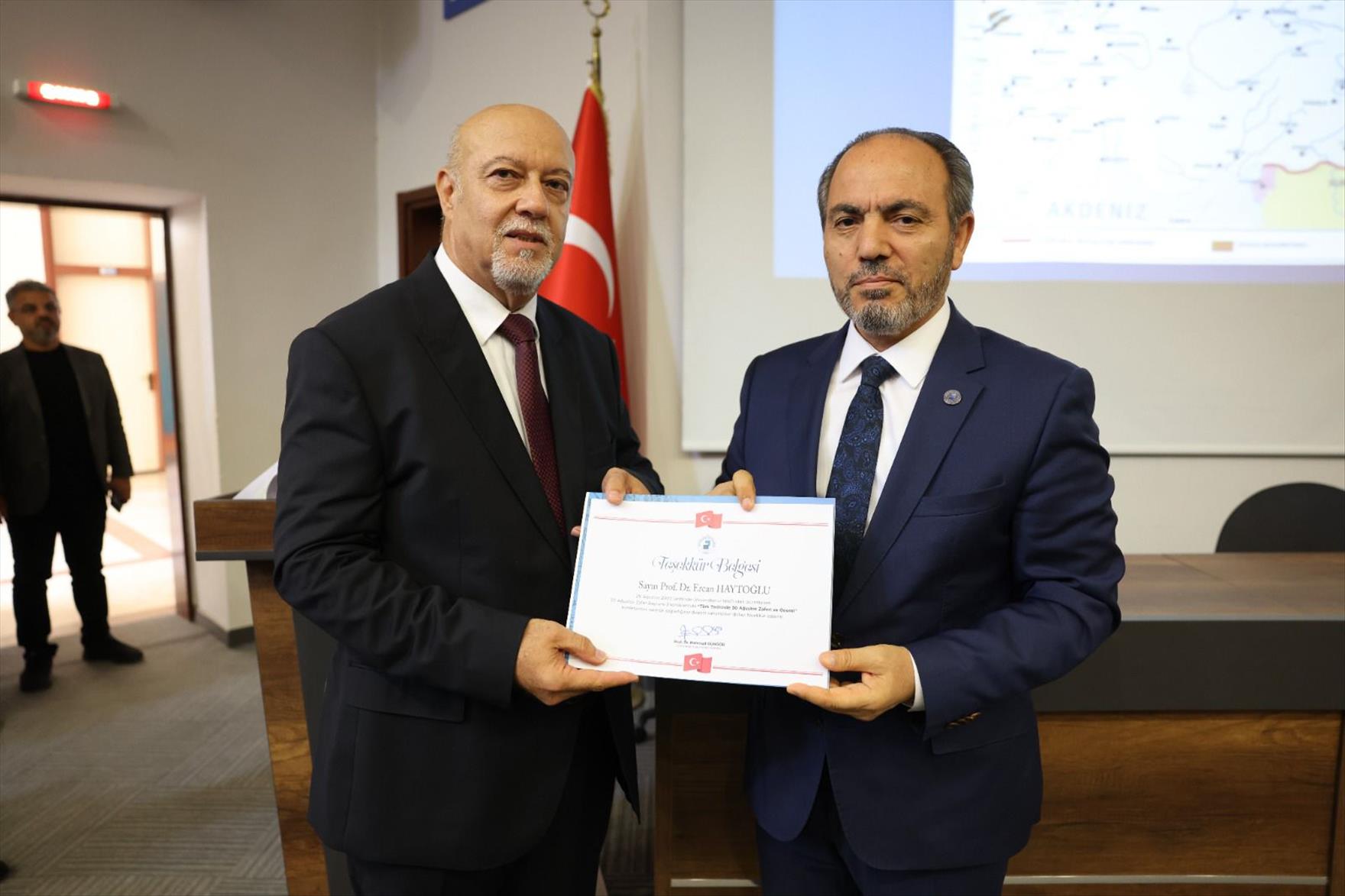
At the end of the conference, Rector Prof. Dr. Mahmud Güngör presented a certificate of appreciation to Prof. Dr. Ercan Haytoğlu for his contributions and remarks.