
Intergenerational Connections Established Through the Book on Tombstones of Cultural Heritage Value in Baklan
The book titled “Tombstones of Cultural Heritage Value in Baklan and Its Neighborhoods,” co-authored by Prof. Dr. Mustafa Beyazıt and Prof. Dr. Yasemin Beyazıt, was introduced at Pamukkale University Faculty of Humanities and Social Sciences. The book is a new outcome of the “Ottoman Tombstones in Denizli Province and Its Districts” field research project, conducted under the motto “Bringing Generations Together.”
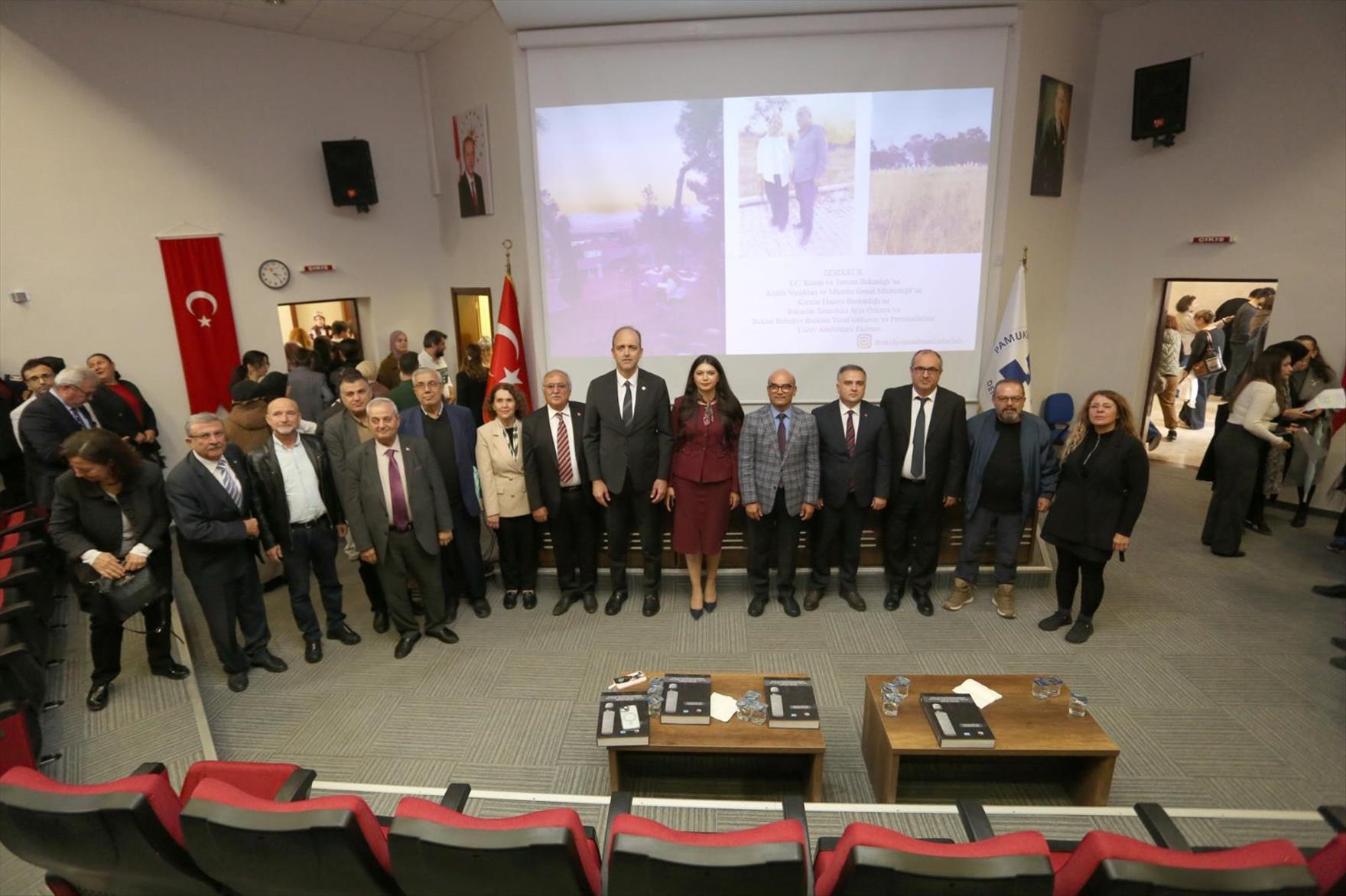
The launch meeting of this study, which makes a significant contribution to the history and cultural heritage of Denizli, was held with the participation of Baklan District Governor Kezban Yerlikaya, Kale District Governor İbrahim Gökçe, Baklan Mayor Yusuf Gülsever, Vice Rector İbrahim Türkçüer, Dean of the Faculty of Humanities and Social Sciences Prof. Dr. Bilal Söğüt, Head of the Department of Art History Prof. Dr. Mustafa Beyazıt, faculty member of the Department of History Prof. Dr. Yasemin Beyazıt, other academic staff, representatives of non-governmental organizations, and students.
In his opening speech, Dean of the Faculty Prof. Dr. Bilal Söğüt said:
“As an institution, I would like to express our great satisfaction with the book Tombstones of Cultural Heritage Value in Baklan and Its Neighborhoods, co-authored by Prof. Dr. Mustafa Beyazıt, a faculty member of our Department of Art History, and Prof. Dr. Yasemin Beyazıt, a faculty member of the Department of History. Denizli's selection as one of the four pilot regions designated across Türkiye by the Ministry of Culture and Tourism for research on tombstones was made possible through the work of Prof. Dr. Mustafa Beyazıt and his team.
“The field research project titled ‘Ottoman Tombstones in Denizli Province and Its Districts,’ carried out by Prof. Dr. Mustafa Beyazıt and his research team under the motto ‘Bringing Generations Together,’ has resulted in the publication of numerous books to date. Books on the tombstones of Denizli-Kale, Denizli-Çivril, and Denizli-Beyağaç have already been published. Prof. Dr. Mustafa Beyazıt and his team continue their work tirelessly. Today, we are delighted and proud to introduce the new book on Baklan and share the findings presented in it with you. The book Tombstones of Cultural Heritage Value in Baklan and Its Neighborhoods, co-authored by Prof. Dr. Mustafa Beyazıt and Prof. Dr. Yasemin Beyazıt, makes a significant contribution to the history and cultural heritage of Denizli.”
In her opening speech, Baklan District Governor Kezban Yerlikaya stated:
“Today, we have gathered here on the occasion of the presentation and conference of an extremely valuable study that sheds light on the deep-rooted history, culture, and identity of our beautiful district, Baklan. Our cemeteries and tombstones, inherited from our ancestors, are not merely burial grounds or blocks of stone. They are bridges connecting our past with our future and silent yet powerful witnesses to our civilization and history. Each one is a unique historical document that conveys the social life, belief systems, aesthetic and artistic understanding, and even linguistic characteristics of the period to which it belongs.
“The book, prepared as a result of the field research conducted with the permission of our Ministry of Culture and Tourism, is a monumental work in terms of documenting the historical memory of our district. Through meticulous research carried out in 15 different cemeteries across the district, a total of 629 tombstones dating from the Ottoman period and the Republican period, which continued this tradition, were individually examined. Their inscriptions, figures, types of headpieces, and ornaments were scientifically evaluated and documented. In this way, our ancestral heritage, which might otherwise have remained vulnerable to the destructive effects of time and nature, has been preserved through a scholarly publication.
“On behalf of my district and myself, I would like to express my gratitude to everyone who contributed to this valuable study and the publication of the book, particularly our esteemed professor Prof. Dr. Mustafa Beyazıt, as well as the academics who contributed, our Ministry of Culture and Tourism, Pamukkale University, and all other stakeholders involved.
“I hope that this work will contribute to the preservation of the cultural heritage of Baklan and Denizli, its transmission to future generations, and the development of new academic studies. I once again extend my respectful greetings to you all.”
In his opening speech, Baklan Mayor Yusuf Gülsever said:
“Once again, I would like to thank our professors who, through great effort, meticulousness, and dedication, have produced the work titled The Historical and Cultural Heritage of Baklan, prepared in cooperation between Pamukkale University and Baklan Municipality and dedicated to the cherished memory of Alperen Hüsamettin Gazi. This work aims to pass on and remind future generations of the cultural heritage we have inherited from our ancestors in Baklan and its neighborhoods, and has now become part of our cultural life.
“History is the accumulation of knowledge about past events, wars, victories, and important figures. History is a nation's memory, a society's identity, the roots of a civilization, and a roadmap extending into the future. It is the bridge built between yesterday and today. We cannot properly understand our present without knowing our past. Nor can we build our future on solid foundations without understanding our present.
“Art can also be defined as a way of expressing human emotions, thoughts, beliefs, and the spirit of the age through an aesthetic understanding. Sometimes art appears as a motif carved into stone, sometimes as a work embodied in the architecture of a mosque, sometimes in the inscription of a fountain, sometimes in the lyrics of a folk song, and sometimes in a few lines of writing on a tombstone.
“A work is a lasting mark that human beings leave on the world in which they live. It may be a bridge, a fountain, a mosque, a tombstone, a handicraft, or a book. Historical monuments are not merely physical objects. They are silent witnesses from the past that have reached the present. Traces of history are sometimes hidden along a village road, sometimes behind the door of an old house, sometimes in a cemetery, sometimes in the shade of a centuries-old tree, and sometimes in the memories of our elders.
“This work is an extremely valuable legacy for our Baklan. We carry the responsibility of passing this meaningful work, this legacy, on to future generations.
“When we look at the history of Baklan, we see a settlement whose roots extend far back into the past. One of the important figures in the history of our district is Hüsamettin Gazi, also known as Hüsamettin Dede. As one of the frontier commanders of the Anatolian Seljuk State, Hüsamettin Dede holds an important place in the historical identity of our district. The tomb built in his name is an indication of how significant a commander and historical figure he was.
“Baklan underwent various administrative and social changes during the Ottoman period. In 1425, it became part of the Anatolian Eyalet, which was centered in Kütahya. Known as the District of Baklan between 1581 and 1867, Baklan became a subdistrict in 1885. Established as a municipality in 1953, Baklan attained district status in 1990.
“From the past to the present, Baklan has preserved its existence, identity, and culture. It is a deeply rooted Anatolian settlement that bears the traces of our glorious history. Baklan has a distinctive historical and cultural identity and played a role in the Turkification of Anatolia and the establishment of Turkish-Islamic civilization in this region.
“Memories that are not documented are eventually forgotten. Monuments that are not protected disappear. History that is not told loses its connection between generations. With these thoughts in mind, we are working on creating a new publication in cooperation with our university, one that will describe the history and cultural structure of Baklan.
“The work titled The Historical and Cultural Heritage of Baklan will be a lasting source that will continue to be consulted, read, researched, and passed on to future generations, not only today but also in the years to come. This work is an expression of our loyalty to Baklan's history, our respect for our past, and our responsibility towards future generations.
“I wish that this work, prepared in cooperation between Pamukkale University and Baklan Municipality, will bring prosperity to our district, the world of history and culture, and future generations.
“I respectfully remember with mercy, gratitude, and appreciation our ancestors who made these lands our homeland, the cherished memory of Alperen Hüsamettin Gazi, and all our elders who served Baklan from the past to the present and are no longer among us.
“Our motto is: Never Forget Our Roots and Identity; Keep Our Culture Alive.
“I thank you all for your participation and extend my love and respect.”
In his opening speech, Vice Rector Prof. Dr. İbrahim Türkçüer stated:
“History is a nation's memory, a recollection that follows it at all times like a shadow. Consciousness is a fundamental structure formed in human beings through awareness, emotion, perception, and knowledge. When we bring history and consciousness together, the concept of historical consciousness emerges, becoming an indispensable concept in the history of nations and states.
“Societies that possess historical consciousness, accurately identify the traces of the past, and interpret them correctly can build their future on firmer foundations. Scholarly studies that shed light on the history of our cities and districts will make significant contributions not only to our cultural heritage but also to our social consciousness.
“Cultural heritage is a general term referring to works created by previous generations and considered valuable to humanity. It encompasses the tangible and intangible values that societies carry from their past into the present and that must be passed on to future generations.
“Our tombstones in cemeteries, which form part of our historical and cultural heritage, are among our most important cultural heritage elements. Tombstones are the silent witnesses of our history. They are unique documents reflecting the social life, belief systems, artistic understanding, and linguistic characteristics of their time. A word, a motif, or a historical date engraved on a stone speaks to us from centuries ago and reminds us of who we are and where we come from. For this reason, tombstones are not merely symbols; they are also carriers of our cultural identity.
“I would like to congratulate everyone involved in the study titled Tombstones of Cultural Heritage Value in Baklan and Its Neighborhoods, conducted and published as a book through the cooperation of the Department of Art History at Pamukkale University Faculty of Humanities and Social Sciences and Baklan Municipality. I congratulate Prof. Dr. Mustafa Beyazıt and Prof. Dr. Yasemin Beyazıt, who contributed to this study, as well as the entire research team.
“I would also like to thank Baklan District Governor's Office for its contribution to the programme. I convey the congratulations of our Rector, Prof. Dr. Mahmud Güngör.”
Following the opening speeches, Prof. Dr. Mustafa Beyazıt delivered a conference in which he emphasized that Baklan has a rich cultural heritage and that its tombstones reflect a rich culture in terms of both content and ornamentation. He shared the findings of their research on Baklan's tombstones with the audience, presenting the information neighborhood by neighborhood. He also expressed his gratitude to Baklan Mayor Yusuf Gülsever for his contributions during the research process and the publication of the book. He noted that their research aimed to bring generations together.
Following the conference, the programme concluded with the authors presenting the book to the Dean of the Faculty, Prof. Dr. Bilal Söğüt; the presentation of certificates of appreciation to the authors; and Vice Rector Prof. Dr. İbrahim Türkçüer presenting a certificate of appreciation and a plaque to Baklan Mayor Yusuf Gülsever.