
The Relationship Between Income Growth, Ecological Footprint and Renewable Energy Discussed at Midday Seminars
As part of the “Midday Seminars” organised by the Faculty of Economics and Administrative Sciences at Pamukkale University (PAU), Prof. Dr. Reşat Ceylan, a faculty member of the Department of Economics, delivered a presentation on Thursday, 5 November, titled “Does Income Growth Primarily Affect the Ecological Footprint or Renewable Energy? New Evidence from India.”
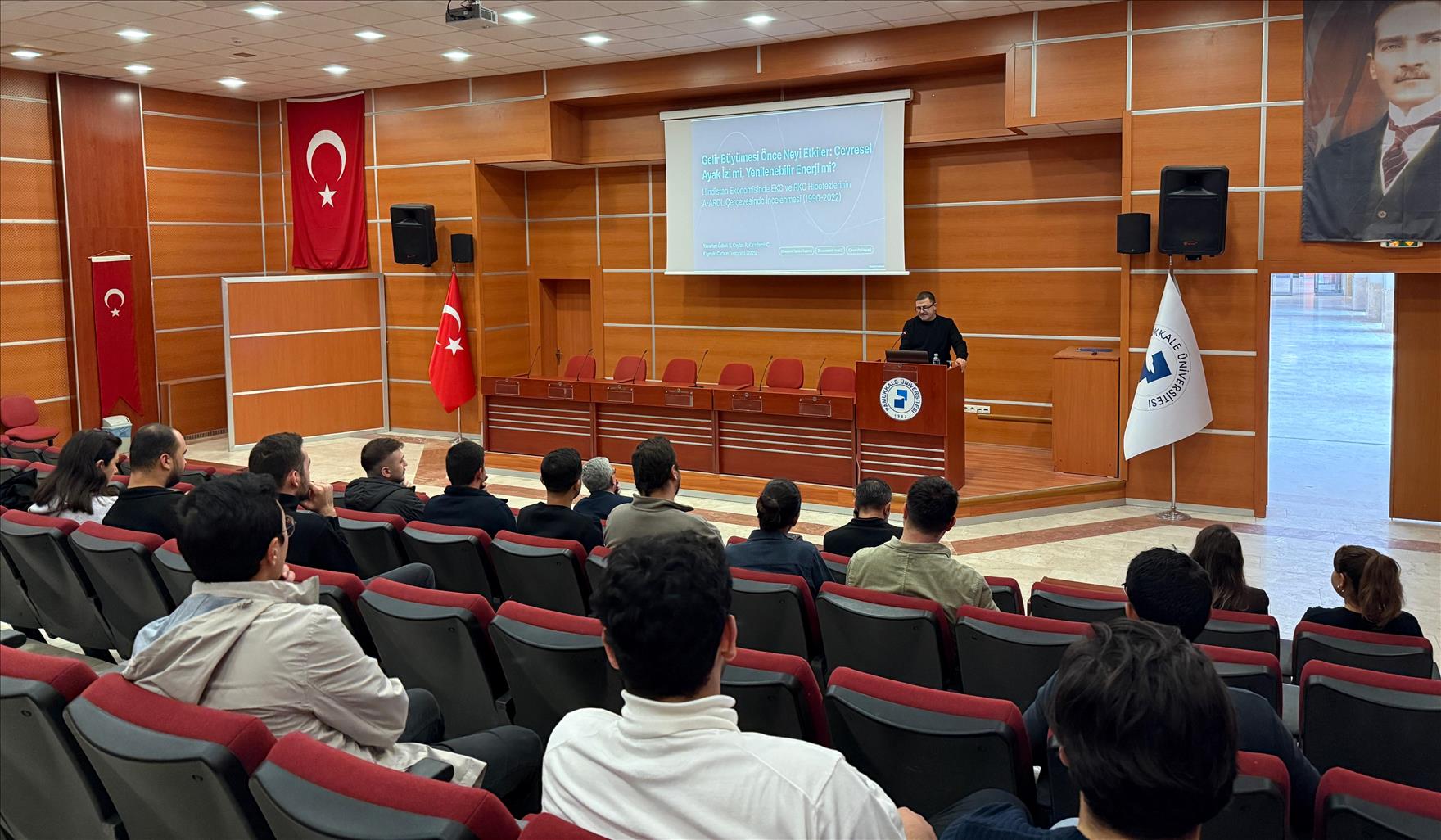
The seminar addressed the relationship between income growth, environmental degradation and renewable energy in the Indian economy. Held at the Şehit Piyade Teğmen Bekir Can Kerek Conference Hall in Block A of the Faculty of Economics and Administrative Sciences, the seminar featured a presentation by Prof. Dr. Reşat Ceylan of the Department of Economics, titled “Does Income Growth Primarily Affect the Ecological Footprint or Renewable Energy? New Evidence from India.”
Prof. Dr. Ceylan shared the findings of their study, conducted within the framework of the Environmental Kuznets Curve and Renewable Energy Kuznets Curve approaches. Explaining that the study employed two separate models to examine the factors influencing the ecological footprint and renewable energy consumption, Prof. Dr. Reşat Ceylan stated that the long-term effects of income, fossil energy consumption, trade openness and urbanisation were analysed. According to the findings, fossil energy consumption significantly increases environmental pressure, while trade openness both helps limit environmental degradation and supports the use of renewable energy through technology diffusion. Prof. Dr. Ceylan also emphasised that India reached a turning point in renewable energy before environmental degradation peaked. He noted that this finding indicates that the green structural transformation began before environmental pollution reached uncontrollable levels, highlighting an important window of opportunity for sustainable development.
In the final part of the seminar, policy recommendations were discussed, including green financing mechanisms, reducing the costs of green investments, and prioritising renewable energy and energy efficiency in urbanisation processes. Following the question-and-answer session, Assoc. Prof. Dr. Fatih Akçay, Vice Dean of the Faculty of Economics and Administrative Sciences, presented a certificate of appreciation to Prof. Dr. Reşat Ceylan.