
Conference Held at PAU on “The Historical Development of Republican Thought in Türkiye and Atatürk”
To mark the 103rd anniversary of the founding of the Republic of Türkiye, Pamukkale University (PAU) held a conference titled “The Historical Development of Republican Thought in Türkiye and Atatürk.”
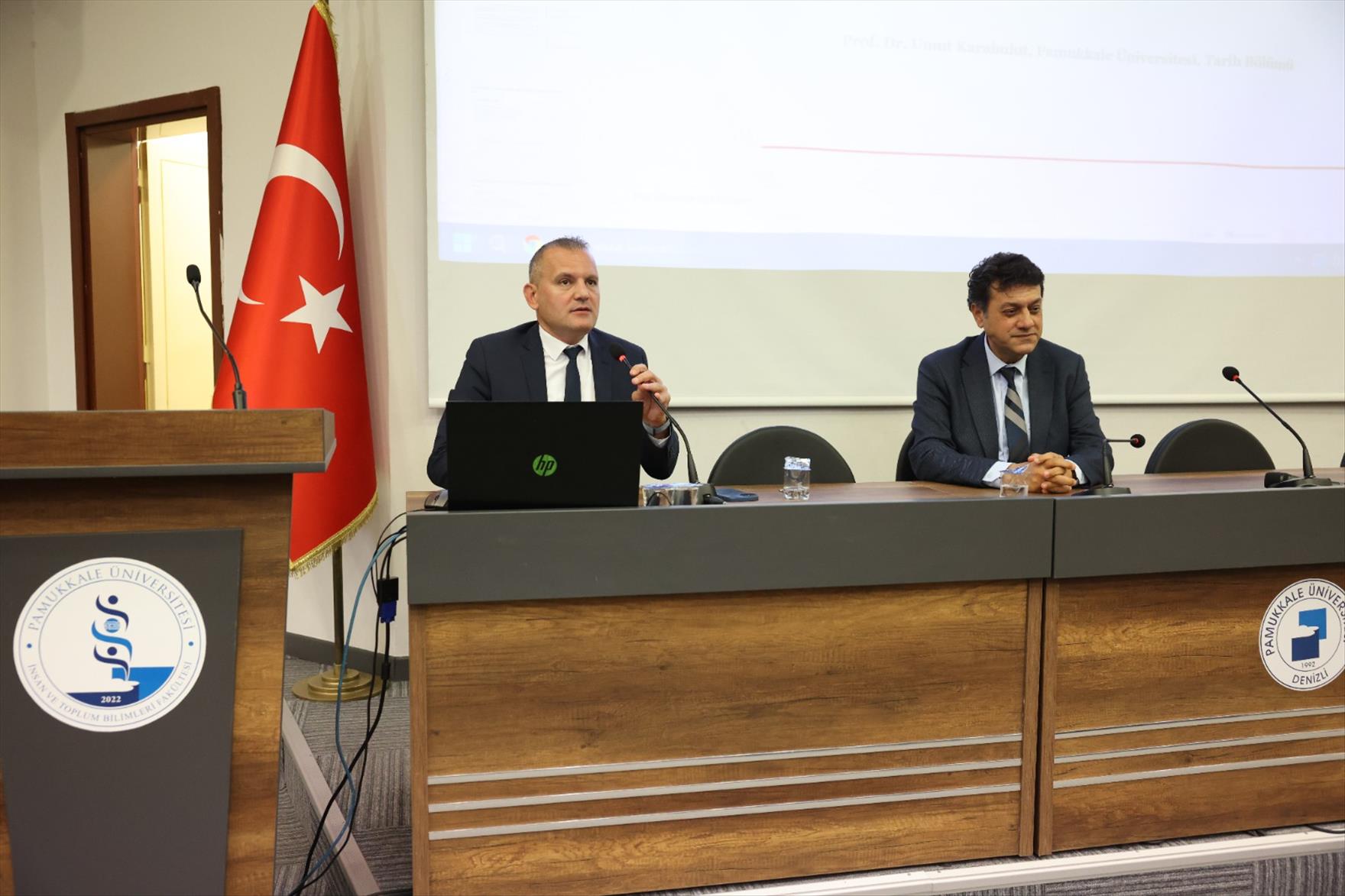
The event was held at the Prof. Dr. İsmail Çetişli Conference Hall, Faculty of Humanities and Social Sciences at PAU. Prof. Dr. Mithat Aydın, a faculty member of the Faculty of Education, and Prof. Dr. Umut Karabulut, a faculty member of the Faculty of Humanities and Social Sciences, each delivered a presentation.
“If you examine ancient Turkic monuments, you can see that they display certain democratic characteristics”
In the first part of the conference, Prof. Dr. Mithat Aydın delivered a presentation on the concept of the republic and its historical development. Defining a republic as a system based not on the will of a single person but on the will of more than one person, Prof. Dr. Aydın continued:
“Not every republic may be democratic. Just as we saw the earliest examples of non-democratic republican governments in aristocratic administrations (aristocratic republics) during the Ancient Greek and Ancient Roman periods, it is also possible to encounter non-democratic examples in our own age. There are republics governed by military and ideological dictators, as well as examples based on democratic systems. We should regard the republican form of government, which is the system of government in our country today, as the outcome of a long process of Enlightenment and revolutions. One of the fundamental principles of a republic is the election of the head of state through elections. In particular, it can be defined as a system in which power belongs to the people/the public. If you examine ancient Turkic monuments, you can see that they display certain democratic characteristics. The foundations of the Republic of Türkiye are, in fact, based on the ideas of the Age of Revolutions.”
“Mustafa Kemal Pasha acted on what he believed in and led a struggle carried out by the nation”
In his presentation, Prof. Dr. Umut Karabulut examined three main periods: the Constitutional Era of the Ottoman Empire (1876–1908), the National Struggle (1919–1923), and the period from 1924 to 1937. He stated:
“As my colleague Prof. Dr. Mithat Aydın also mentioned, the concept of the republic did not emerge all at once. The republic also has a historical background in these lands. During the Ottoman period, the idea of the republic manifested itself through debates on meşveret (consultation and assembly), meşrutiyet (constitutional government and rule in accordance with a constitution), cumhur (the people), liberty, and sovereignty. The second period is the National Struggle. Here, alongside the war, we will see how the historical foundations of the republican regime took shape and became institutionalized before it was officially proclaimed as a republic. The third period concerns the proclamation of the regime and how this ideology became established.
“The Tanzimat Period of the 19th century is important. It can be seen that the Young Ottomans and the Young Turks discussed various concepts that contributed to the emergence of republicanism in Türkiye. In addition to the Constitutional Era, the Balkan Wars and the First World War must also be discussed. We should point out that Türkiye's transformation into a nation-state also took place alongside the development of republicanism. As the country transformed from an empire into a nation-state, lost territories in the Balkans, and then lost its Arab provinces during the First World War, the population remaining in the territories it retained increasingly came to consist of Turkish and Muslim communities. As we know, Türkiye emerged as a nation-state through this process. This paved the way for republicanism to become the form of government adopted by nation-states.
“With the Armistice of Mudros and the transformation of the remaining territories into areas inhabited by Turkish and Muslim communities, the Ankara Government gained legitimacy in the context of the peace agreements shaped by the Wilsonian Principles of the period. We made very effective use of this approach during the National Struggle as well. Mustafa Kemal Pasha acted on what he believed in and led a struggle carried out by the nation. This nationally driven struggle played a major role both in achieving victory and in securing international legitimacy.”
Following the presentations, the programme concluded with the presentation of certificates of appreciation.